# #| echo: false
# #| column: margin
# from phasic.utils import download_link
# download_link(__vsc_ipynb_file__) The Coalescent
The sequence of tutorials show-cases the complete Python API of the Phasic library, a high-performance computational framework for modelling inference on waiting times in Markov jump processes. In addition to this introduction, the tutorial covers the following topics - in each as a jupyter notebook you can download and play with yourself.
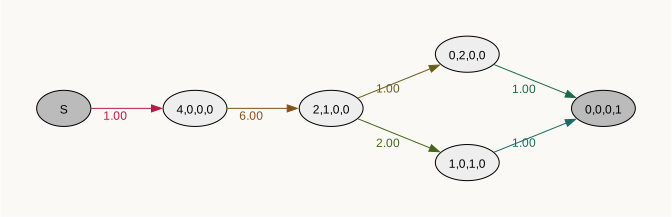
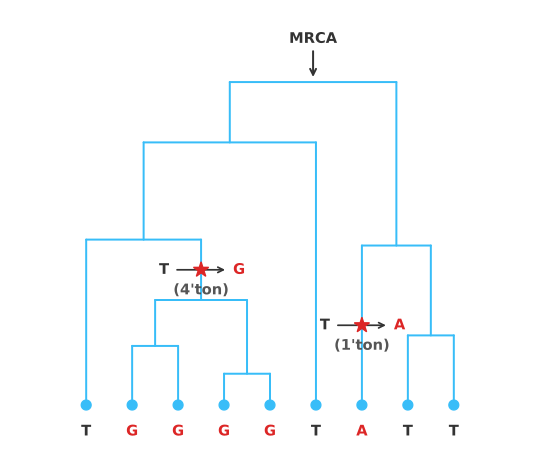
Throughout the tutorials we use the Coalescent model as an example. The Coalescent is a continuous-time Markov chain that models the ancestry of a sample of individuals from a population. Lineages coalesce into fewer lineages with more descendants until only a single common ancestral lineage remains. Branches in the resulting tree represent lineages. We call those with a single sampled descendant singleton lineages. The ones with two descendants are doubletons and so on. With four samples, the Coalescent jumps with four singletons and terminates with a single quadrupleton (4’ton). We can encode the states of this Markov chain as vectors enumerating the number of of 1’tons, 2’tons, 3’tons, and 4’tons.
from phasic import Graph # ALWAYS import phasic first to set jax backend correctly
import numpy as np
import seaborn as sns
from vscodenb import set_vscode_theme
set_vscode_theme()
sns.set_palette('tab10')